The court.

A padel court is 20 metres long and 10 metres wide, roughly a third of the size of a tennis court, and enclosed on all sides. Boundary lines divide the court into service boxes, with a net running across the middle.

The back walls and parts of the side walls are made of toughened glass, standing around 3 metres high, with metallic mesh fencing making up the rest. The surface is made of artificial turf, often coloured vibrant blue, green or brown.
How to win a point.

Padel is always played as doubles and the aim is simple: keep the ball in play until your opponents can’t return it.

A point ends when the ball bounces twice on one side, when a shot goes into the net, or when a shot flies out of the court over the fence.

You also lose the point if your shot hits the opponents’ wall or fencing before it has bounced oin their side of the court, if the ball strikes you or your partner, or if the server serves two faults in a row.

Serving.

Serving in padel is underarm, which makes it one of the easiest serves to learn compared to other racket sports. Stand behind the service line, bounce the ball once on the ground, and strike it at or below waist height. The serve must travel diagonally and land in the service box across from you, just like tennis.

One player serves for a whole game. You start from the right, then switch to the left for the next point, alternating sides like that until the game is won, with two attempts each time. Once the game is over it’s the other team’s turn, and serving works its way around all four of you as the match goes on.

After the ball bounces in the box it can touch the side glass and still count, but if it hits the metal fence it’s a fault. And as in tennis, a serve that clips the net and lands in is a “let” and is simply replayed.

Scoring.

If you’ve watched tennis, you already know padel’s scoring. Points run 15, 30, 40, then game. At deuce (40 all) a team needs two points in a row to take the game. If you lose the advantage point, it’s back to deuce.

You win a set by reaching six games with a lead of at least two games, and if it reaches six games all, a tie-break decides it. In a tie-break, the first team to reach seven points, with a two-point advantage wins the set. Most matches are best of three sets.

One thing to look out for: some clubs and competitions use a “golden point” at deuce, where the very next point decides the game rather than playing two clear points. It keeps things fast, and your coach will tell you which version you’re playing.

Using the walls.

The walls are what make padel so fun. The key rule is that the ball has to bounce on the floor before it touches a wall. Once it has bounced on your side it’s fair game: you can let it come off the back glass or the side fencing and play it back over the net, which is how those long, satisfying rallies happen.

What you can’t do is send the ball straight onto your opponents’ wall. Your shot has to bounce in their court first. If it hits their glass or fencing before bouncing, the point is theirs. It takes a few goes to trust the bounce, but once it clicks, playing the walls becomes one of the best parts of the game.

A fun quirk of the game for more advanced players: If your opponent smashes the ball and it bounces before flying over the glass walls, you’re officially allowed to run outside through the court doors to hit it back.

The key rules at a glance.

You always play in doubles, two against two

Serve underarm, at or below waist height, into the diagonal service box

The ball must bounce on the floor before it hits a wall

After a bounce, you can play the ball off the glass and the fencing

A serve that hits the side glass is good; one that hits the metal fence is a fault

A shot that hits your opponents’ wall or fence before bouncing is out

Scoring works just like tennis: 15, 30, 40, game

Win two sets and the match is yours

Ready to put the rules into practice?

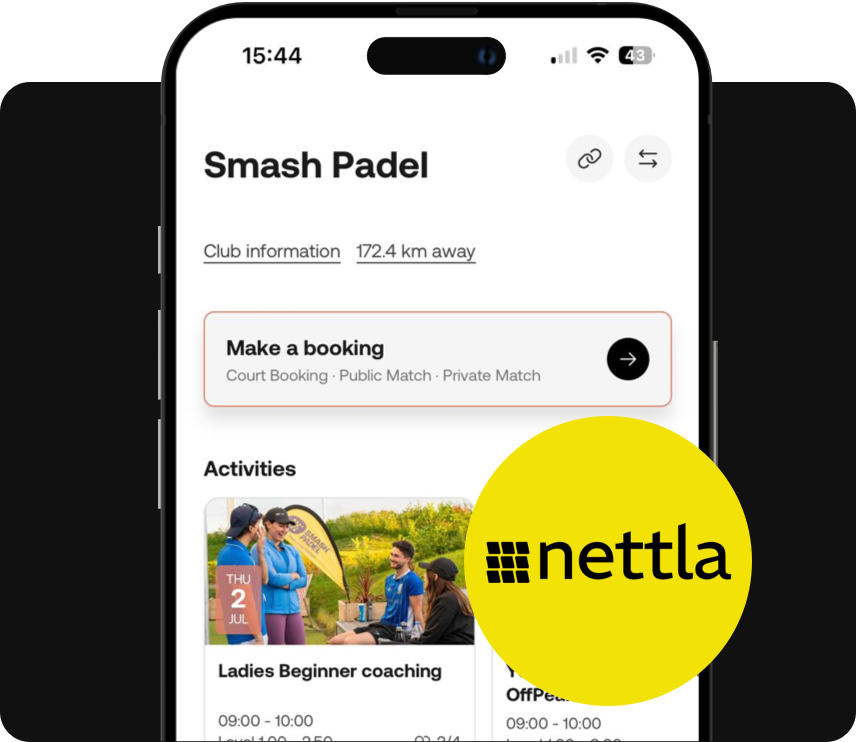
The best way to learn padel is to play it, and your first session is on us. Get the Nettla app to book your free intro at your nearest Smash Padel.

Download the app on the Apple App Store Download the app on the Google Play Store
Ready to put the rules into practice?