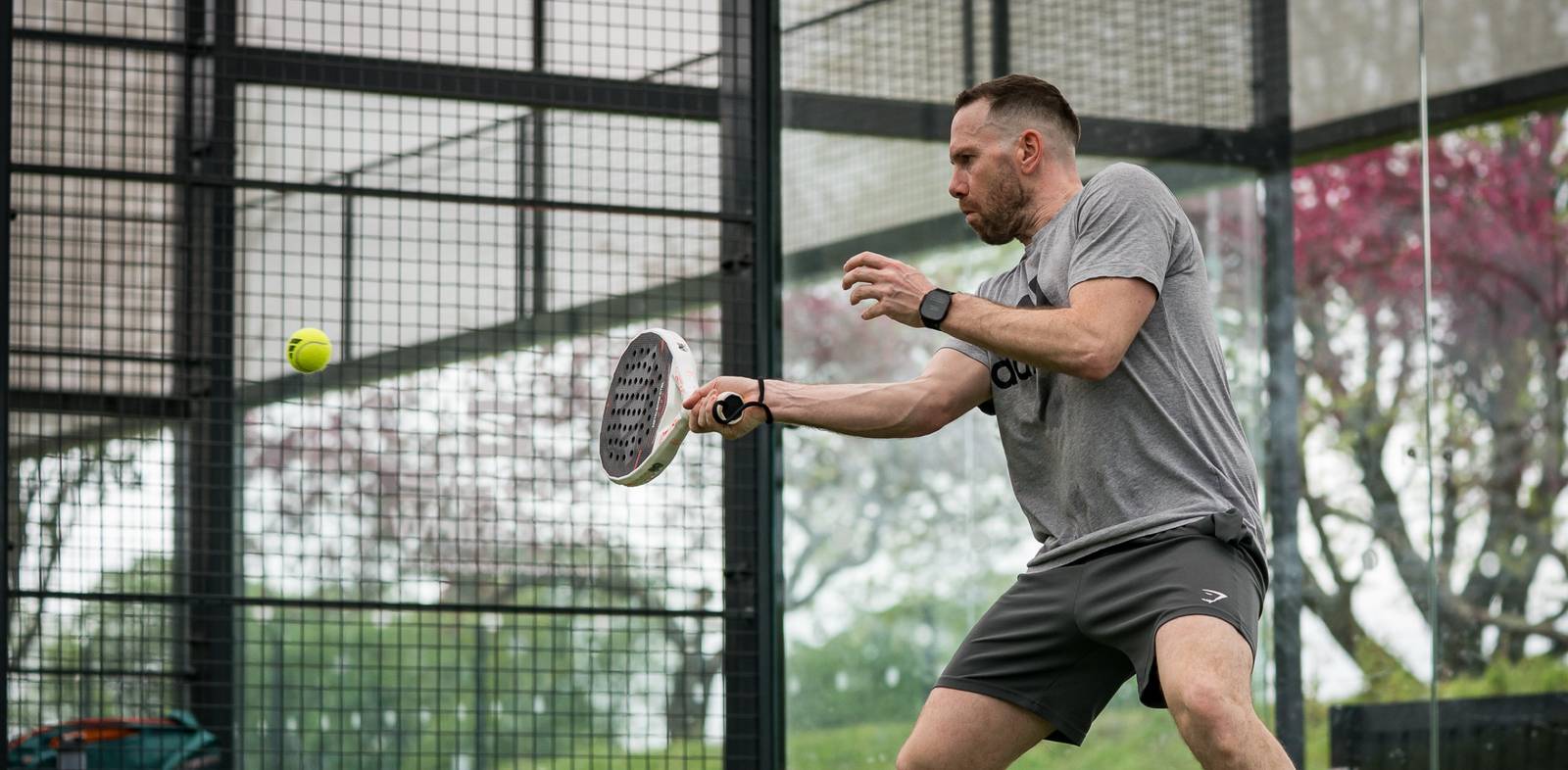

The short answer is yes. Padel gets your heart rate up, keeps you moving for the best part of an hour and works your whole body without feeling like a chore.
Almost any sport will do something good for you because it gets you moving. But the better question is whether you’ll still be playing it in six months: that’s where padel really comes into its own.
What an hour of padel does for your fitness.
Padel doesn’t feel like a gruelling workout while you’re doing it, which is why people can be surprised by the numbers behind it.
Across a match, players cover somewhere between 2,500 and 3,500 metres. All those short sprints, lateral shuffles, and split-steps translate to roughly 4,000 to 6,000 steps, making a single match an easy way to knock out at least half your daily step goal. Heart rate sits at an average of 140 to 160 beats per minute, which is around 70 to 80% of maximum for most people.
Rallies typically run to four or five shots over 10 to 15 seconds, followed by a similar length of rest before the next point starts. These short bursts of effort, followed by short recoveries, bring similar benefits to interval training – which is one of the most effective ways to build cardiovascular fitness. Nobody on a padel court is thinking about it that way though; they’re thinking about the ball coming off the back glass and how to get in position for their next shot.
The LTA estimates that a game of padel can burn over 400 calories, though the real figure will depend on your weight, how long you play and how hard your opponents make you work for it.
There’s a long-term picture too. A study of 80,306 British adults found that people who played racket sports had a 47% lower risk of dying from any cause compared to people who didn’t play them. That was a larger reduction than the same study found for swimming, aerobics or cycling.
Padel keeps you coming back.
One of the hardest parts of staying fit is sustaining momentum. Most people stop exercising because they lose interest, it feels like work, or it just doesn’t fit into their weekly routine.
When you find a sport you enjoy, one you can laugh your way through and play with friends and family, you stop noticing that you’re exercising. You come off court and realise you’ve just spent an hour running around. Padel is one of those sports.
Research shows recreational padel players play two to three times a week, for 60 to 120 minutes a session, and keep it going throughout the year. The NHS advises adults to get 150 minutes of moderate activity a week, or 75 minutes of vigorous activity. Padel sits between the two, with short bursts of hard effort and a breather between points, so with a couple of games a week you’ll hit that goal.
Fast progress, plus the endorphins that come with the game, is what turns padel into something people don’t want to miss rather than something they have to fit in.
A sport that fits around your body.
One of the reasons padel keeps people coming back is that it asks less of you physically than lots of other sports, including tennis and squash.
There are four of you sharing a court roughly a third the size of a tennis court, so there’s far less ground for any one person to cover. The ball is kept at a lower pressure than a tennis ball, so it travels a little slower once it bounces and gives you an extra beat to get there. Points are won through positioning and timing rather than power, which means you don’t need to be strong or fast to play well. The underhand serve also places less strain on the shoulders than an overhead tennis serve.
It’s easy on the joints, which is why padel suits people who’ve had to step away from other more intense sports, and why you’ll find players enjoying it well into later life.
An hour to clear your mind.
Ask people what they get out of padel and fitness is rarely the first thing they mention.
What comes up instead is that for an hour, there’s no room in your head for anything else. The ball keeps arriving. You’re reading the court, watching your partner, working out where the gap is going to open up. Whatever you brought with you from work or from home doesn’t make it past the door of the court, because there simply isn’t the spare attention to hold onto it.
Exercise of almost any kind is good for how you feel, and there’s a lot of evidence behind that. The research on padel sets out the wider picture well: regular activity helps with stress, mood and anxiety, and supports things like concentration, memory and how quickly you process what’s in front of you.
It’s also the thinking behind Sofa 2 Smash, an eight-week programme we ran at Bicester to tackle inactivity. Modelled on the NHS Couch to 5k and led by a coach with a background in NHS mental health services, it was built around the idea that getting people moving in a way they enjoy does more than improve their fitness. Results showed improvements in participants’ mental wellbeing, self-reported health, physical activity and exercise levels.
The social side of padel.
Padel is played in doubles so there are always four of you on court. You chat between points, work out tactics with your partner and often grab a drink afterwards. For a lot of our players, the social element is what turns one session into a habit. It’s much easier to keep something up when three other people are expecting you.
There’s some evidence that this matters more than we tend to assume. In a study that followed more than 8,500 people for 25 years, the activities linked to the biggest gains in life expectancy were the ones you can’t do on your own. So the social side isn’t only what makes padel enjoyable. It may be part of why it’s good for you, and it’s certainly a big part of why people come back.
Smash story: feeling the benefits of padel.
“It’s had a massive impact on my mental and physical health and socially too. I’ve now got back into fitness. It’s just built up a bit more confidence to do more regular exercise.
I suffer with mental health issues and find it very difficult meeting new people. But from the very beginning, we were all at the same sort of level. It was a very fun, structured way of learning the game of padel, getting fitter and finding a new hobby.”
– Gemma Bridges, Participant in Smash Padel’s ‘Sofa 2 Smash’ programme
Getting the most out of padel.
If you want padel to do as much for you as it can, a few simple habits help:
- Aim for twice a week: that’s the sweet spot where consistency builds.
- Warm up properly: spend five minutes activating your ankles, hips and shoulders before stepping on court.
- Keep basic strength work going: a little leg and core work off-court makes a noticeable difference on court.
- Play with slightly better players: it stretches your skills without feeling outmatched.
- Get movement advice early: working with a coach on your footwork early prevents awkward habits and helps you avoid aches later.