
Padel is by far the newest of the three sports. It was invented in Mexico in 1969, when a businessman called Enrique Corcuera built a smaller, walled version of a tennis court at his home. Modern outdoor lawn tennis dates back to 1873 in Britain (though a previous version of the sport began in 12th-century France), and squash grew out of a schoolboy game at Harrow School around 1830.
Padel is now the fastest growing sport in the UK and sits somewhere between tennis and squash, borrowing something from each to become its own game. How it compares is one of the questions we hear most from people weighing up which sport to try.
If you’ve played tennis or squash before, some of this will feel familiar. If you haven’t, that’s fine too – padel is an inclusive sport that’s easy for beginners to pick up. Here’s how the court, the equipment, the pace and the learning curve compare, and how to work out which sport suits you.
The court and rules.
The biggest difference between the three sports is the space you’re playing in and what’s allowed to happen at the edges of it.
Here’s what the courts look like:
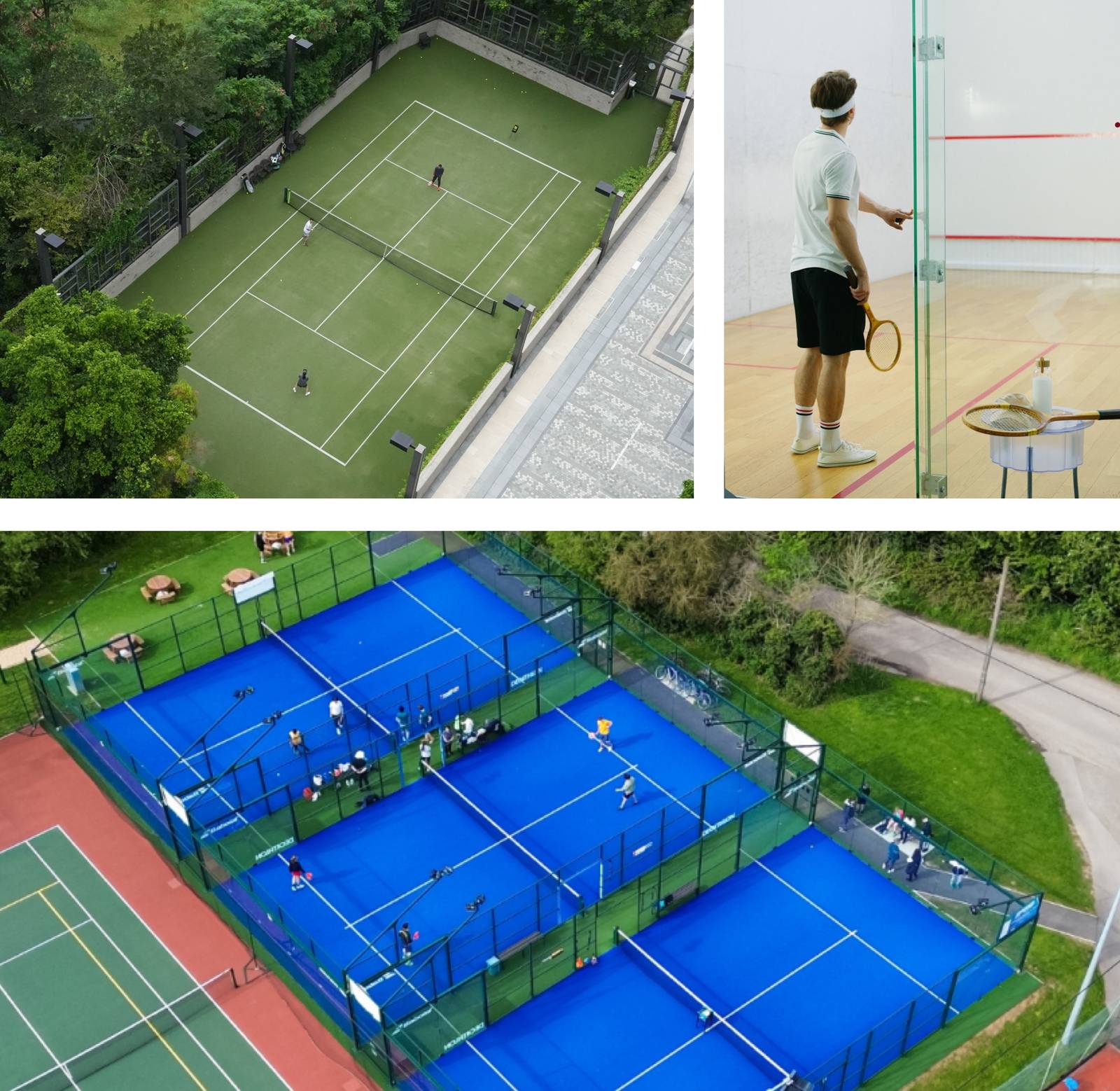
Padel and squash both use walls as part of play, but in different ways. In padel, the glass and fencing only come into it once the ball has bounced, which keeps the point alive rather than ending it early. The serve is the exception: it must bounce before touching the glass, and it’s a fault if it clips the fence. In squash, every wall is fair game throughout the rally, not just after a bounce.
Scoring is where padel and tennis overlap. Both use 15, 30, 40, game. If both teams reach a score of 40-40 (deuce), the game must be won by a two-point margin. Six games are needed to win a set, and matches are usually played over three sets. If a set reaches 6-6, a tie-break is played, where players must win seven points, with a two-point lead.
Squash counts points to 11, with matches typically the best of three or five games, so a squash match can be over far more quickly than a padel or tennis match.
| Padel | Tennis (doubles) | Squash (singles) | |
| Court size | 20m x 10m | 23.77m x 10.97m | 9.75m x 6.4m |
| Enclosed? | Fully, glass and fencing (though you are allowed to run through the door to hit it back) | No | Fully, four walls |
| Surface | Porous concrete, artificial turf or carpet, usually green, blue or terracotta | Grass, clay or hard court | Wood or synthetic, kept pale to contrast with the ball |
| Net/wall height | Net around 88-92cm | Net 0.91m centre, 1.07m at posts | Front wall 4.57m |
| Serve | Underarm, diagonal | Overarm | Off the front wall |
| Format | Doubles only | Singles or doubles | Mostly singles |
The equipment.
For all three sports, all you need is a racket and ball (as well as sportswear you can move around in and a good pair of trainers).
A padel racket is solid and stringless, made from composite materials with a perforated face, and considerably shorter than a tennis racket. There’s no restringing or tension to think about, which is one less thing to maintain compared with tennis or squash. Tennis and squash rackets are both strung, with a squash racket carrying a smaller, more elongated head built for reach in a tight space.
A padel ball looks like a tennis ball but is kept at a lower pressure (around 10 to 11 psi, versus 14 for tennis), so it travels a touch slower once it bounces. A squash ball is smaller again and barely bounces at all when cold, which is why players often knock one against the wall before starting to warm it up. Squash balls also come in different speeds, marked by a coloured dot, so beginners can play with a livelier ball while they build control.
[Photos of each racket + ball type].
Physical demand and pace.
With four players sharing a padel court, there’s less ground for any one person to cover, and the enclosed space means the ball rarely goes far. The walls and the slower bounce buy you an extra beat to think before playing your shot, so points tend to be built rather than rushed. Padel is easy on the joints, which is why it works so well for players of any age.
Tennis singles asks more of your speed and endurance, since you’re covering the full width and length of the court alone. Squash is the most physically demanding of the three: a small court, four walls in constant use and a fast ball make for short, sharp rallies and a session that can feel closer to interval training than a game – demanding lightning-quick reactions.
The learning curve.
This is where the differences really start to matter for anyone deciding where to begin. The court size, the slower ball and the doubles format all give padel a much shorter learning curve: most people are rallying properly within their first session, since there’s more time to react and more margin for a mistimed shot. Tennis takes longer to feel competent at, largely because of the technical demands of the serve and groundstrokes needed to control a much bigger, open space. Squash is demanding from the very first point, with little time to recover between shots and not much room for error against those unforgiving walls.
At Smash, coaching is player centred rather than coach led: sessions are built around the player in front of the coach, not delivered from a fixed script. Some people need pushing out of their comfort zone, others need encouragement to trust what they’ve already learned, and a good coach reads which is which. Social sessions are matched by ability rather than by racket sport experience, and our six-week Padel Xpress programme is built to take you from the basics to booking your own court with confidence.
Smash stories: Beginners and seasoned racket players enjoy padel.
“I am really enjoying my New to Padel courses. The courts are great and undercover so we’re able to play if it rains. The coaches Michelle, Purita and Mike are so helpful, positive and encouraging. They make the hour so enjoyable. We have made new friends who we are able to play with too!”
– Suzi Tregenza, Smash Padel Mid Sussex customer
“I can’t recommend trying this sport enough and the staff at Smash Padel make it fun and easy to give it a go. While I have played almost all of the court games in existence I had never played Padel until trying an intro session in Cardiff. Craig, Steve and Matthew were all really friendly and knowledgeable and the intro session was a great mix of instruction and actual match play making for a really fun time. The other attendees were also very friendly (and quite talented) and within that hour I can see why this is such a popular sport around the world.”
– John Geoffroy, Smash Padel Cardiff customer
Which sport suits you?
If you already play tennis, the scoring and the racket sport instincts carry across, though power matters less than positioning and working with a partner. If you play squash, your fitness and reflexes will help, and you can expect a more social, doubles based game that’s easier on the body. If you’ve never played a racket sport at all, padel is genuinely the easiest of the three to start with, and is often loved by people who wouldn’t typically consider themselves natural ball players.